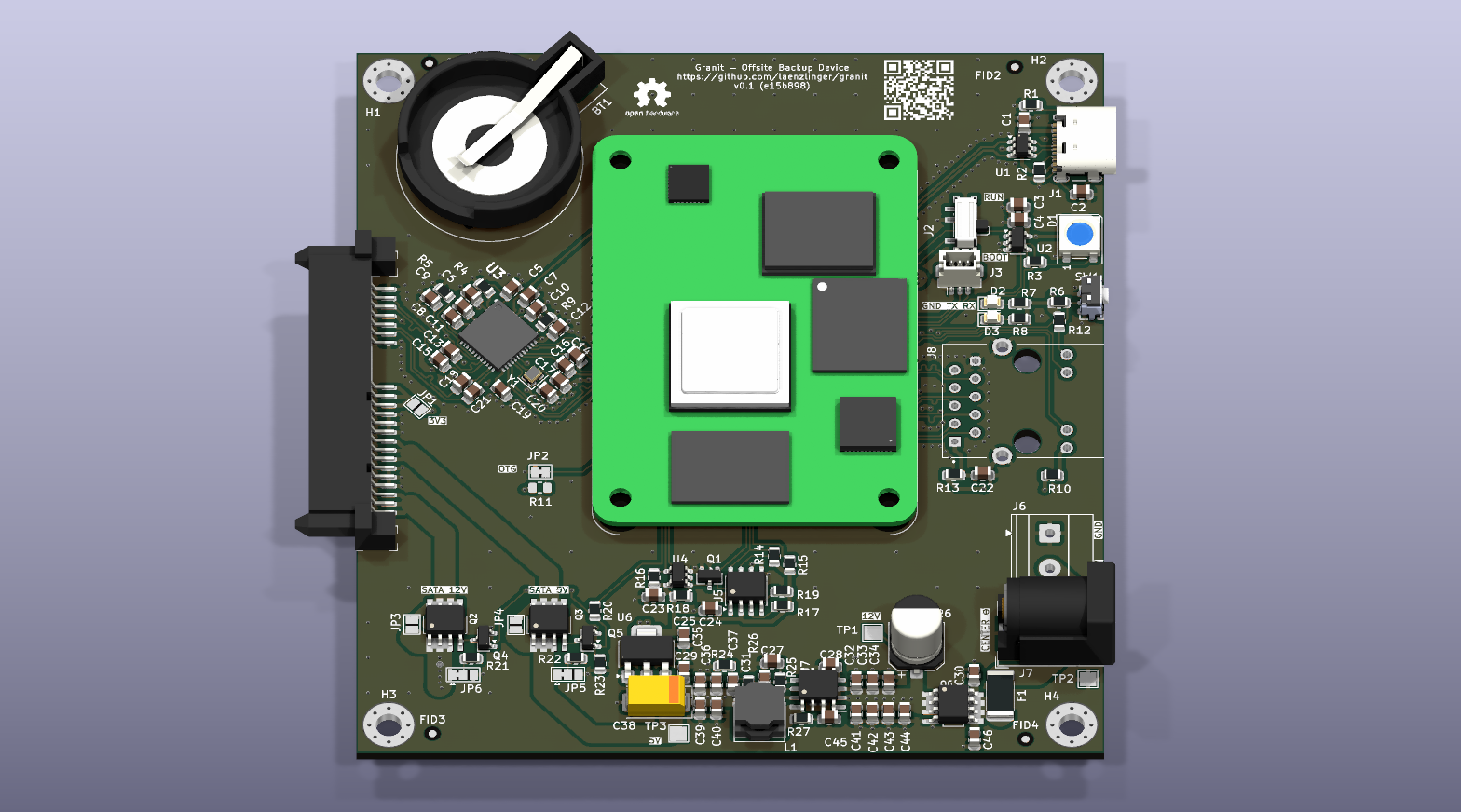
An open hardware offsite backup appliance based on the Raspberry Pi CM4. A custom carrier board with a PCIe SATA controller, Gigabit Ethernet, and a battery-backed RTC — designed to be left at a trusted location and managed remotely.
Plug in Ethernet, plug in power, done. The device receives encrypted backups over WireGuard, spins down the disk when idle, and costs nothing to operate after the initial build.

Key Specs
- ASM1061 PCIe Gen 2 x1 to dual SATA III — no proprietary firmware required
- Gigabit Ethernet with integrated magnetics (Hanrun HR911130A)
- DS3231 RTC with battery backup for scheduled wake/sleep
- 12V DC input supporting both 2.5" and 3.5" SATA drives
- USB-C OTG for eMMC flashing and initial backup seeding
- Software-controlled HDD power — GPIO-driven P-FET switching, disk only spins when needed
- 4-layer PCB with impedance-controlled differential routing, designed in KiCad 10
- Hammond 1455 aluminium enclosure
- ~€125 BOM cost — pays for itself in under two years vs. cloud backup
PCB Design
The board is a 4-layer design fabricated at JLCPCB with 1oz copper on all layers:
- Top layer: Components, PSU routing, signal traces
- Inner layers: Unbroken GND planes for signal integrity
- Bottom layer: Power distribution (12V, 5V, 3.3V)
High-speed interfaces use impedance-controlled differential pairs:
- PCIe: 100Ω differential to ASM1061 SATA controller
- SATA: 100Ω differential with AC coupling capacitors
- Gigabit Ethernet: 100Ω differential to RJ45 with magnetics
- USB: 90Ω differential for OTG port
Power routing uses dedicated netclasses sized per IPC-2221 (3mm tracks for 12V, 2.5mm for 5V) with parallel vias at layer transitions.
Software
The device runs a minimal Raspberry Pi OS image with:
- WireGuard — encrypted tunnel to home network
- rclone — incremental sync from NAS
- Automated wake/sleep cycle — RTC wakes at configured hour, syncs, shuts down
- Prometheus metrics — remote-write health data (disk usage, sync status, temperature)
- Ansible-provisioned — entire configuration reproducible from code
Image built via pi-gen, all services configured via Ansible playbook.
Roadmap
- v0.3 — First production run (current, assembled on my own pick-and-place machine)
- v0.4 — Fix wake/shutdown latch, barrel jack swap, DF40C alignment bosses
- v1.0 — Validated design with custom OS image and full documentation
- Future — Investigating RISC-V SoM for a fully blob-free variant
Documentation
Hardware documentation is auto-generated via CI: laenzlinger.github.io/granit
Licensed under CERN Open Hardware Licence v2 — Permissive.
Context
This project grew out of my Home NAS Infrastructure — the offsite backup currently runs on a CM5 with a USB-to-SATA cable. Granit replaces that with a dedicated board that’s reliable enough to leave at a remote location unattended.